WEBTOON Entertainment Unveils ToonRadar Report, Confirms 99.8% Defense Rate Against Illegal Distribution of Latest Paid Episodes
Major Illegal Webcomic Site in Korea Shut Down After Government Crackdown and Nine Years of ToonRadar's Supply Blocking
New Purchases Surge Up to 7.9x After Shutdown and Korea Revenue Rises 29.7%, Increasing Creator Payouts
WEBTOON Entertainment announced results from its proprietary anti-piracy technology, ToonRadar, revealing that readers who returned to its official service following the shutdown of "Newtoki" — one of Korea’s largest illegal webcomic sites — have continued to make steady paid purchases. All figures in this release reflect data from NAVER WEBTOON, WEBTOON Entertainment’s domestic subsidiary in Korea, and do not represent global WEBTOON platform performance.
To analyze changes in reader behavior before and after Newtoki's shutdown in April, WEBTOON Entertainment built the report on purchase data from January through August 2026. Titles were divided into three groups based on how quickly they had been illegally leaked before the shutdown: those leaked the same day of official release, those leaked more than a day later, and those with no leaks. To account for other factors that could affect the results, titles from each group were sampled for statistical analysis of overall inflow, retention, and revenue. Titles with irregular or suspended serialization were excluded from the sample.
WEBTOON Entertainment assessed that Newtoki's shutdown resulted from a worsening operating environment for the illegal site, driven by the government's intensified enforcement — including investigative pressure and the announcement of emergency blocking measures — and ToonRadar's continuous blocking of the site's content supply.
A series of copycat and newly launched illegal sites emerged to fill the void left by Newtoki, but continued action from both the government and WEBTOON Entertainment sharply curbed their reach. According to the Korea Copyright Protection Agency (KCOPA), average daily traffic to the three highest-traffic illegal sites fell about 64% — from roughly 4.71 million visits to about 1.71 million — after the government's emergency blocking measures took effect on May 11. WEBTOON Entertainment has also maintained a 99.8% defense rate against the illegal distribution of its latest paid episodes, delaying illegal leaks by three to five episodes relative to official release and undermining the commercial value of pirated content.
To confirm that readers who had turned to illegal channels were returning to the official service after Newtoki’s closure, WEBTOON Entertainment analyzed purchase data for titles whose latest episodes had been leaked the same day they were released on the official service, measuring the scale of returning readers (estimated). The analysis found that new purchases for these titles surged 7.9 times during the week of the shutdown, compared with normal levels (the three-week average immediately before Newtoki's shutdown). Ninety-six percent of these new readers had previously read the same series, indicating that existing readers who had drifted to illegal sites were returning to the official service.
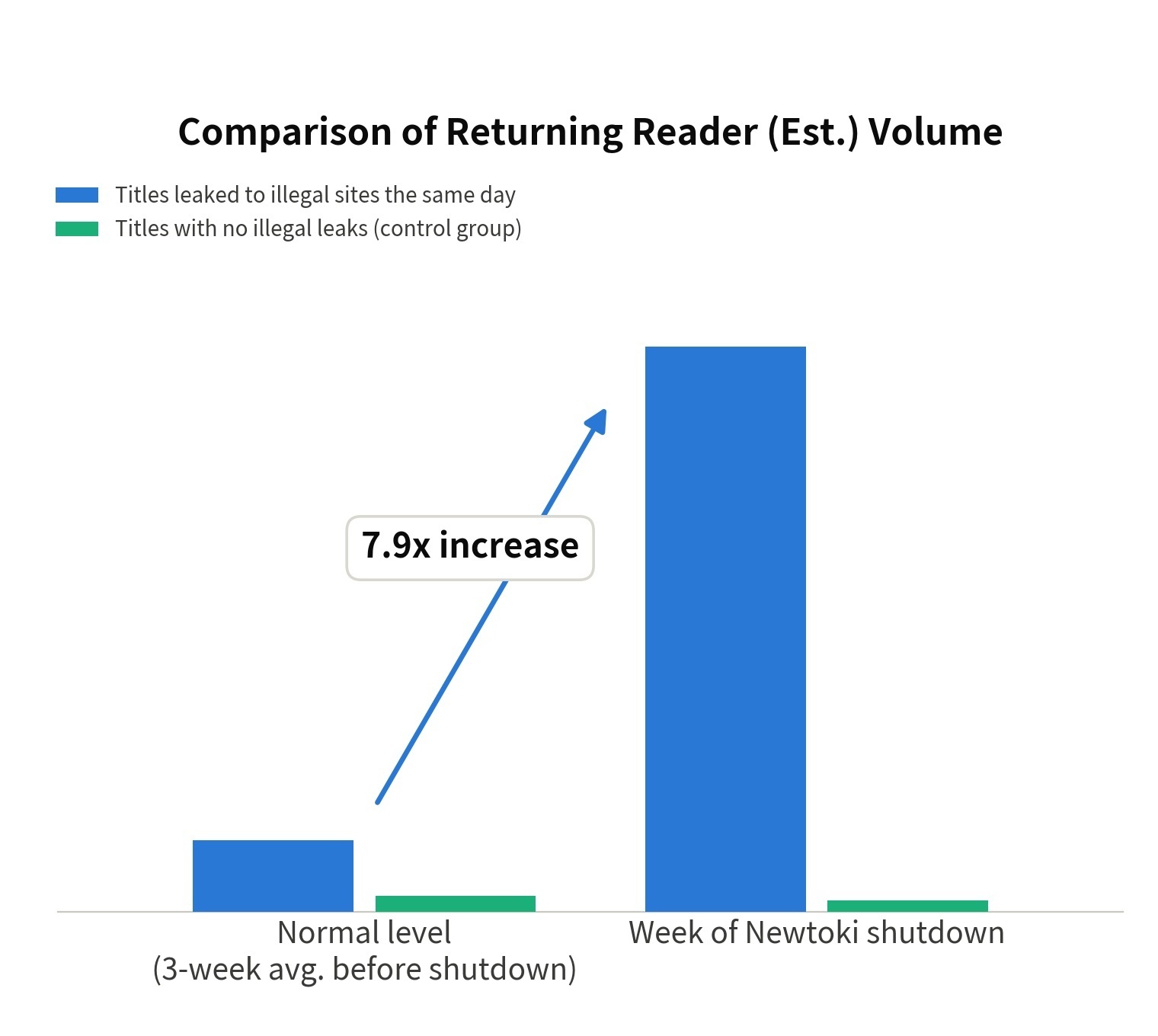
<Figure 1. Comparison of Returning Reader (Estimated) Volume — NAVER WEBTOON, Korea Domestic Service>
Because ToonRadar continued to block the leak of the latest paid episodes to other illegal sites even after Newtoki's shutdown, a significant share of returning readers stayed with the official service rather than leaving again. This retention translated directly into revenue growth: revenue for the same-day-leaked title group on NAVER WEBTOON rose 29.7% in the three weeks immediately following the shutdown, with an additional 11.9% increase over the following three weeks — meaning a greater share of earnings is now flowing back to creators in Korea.
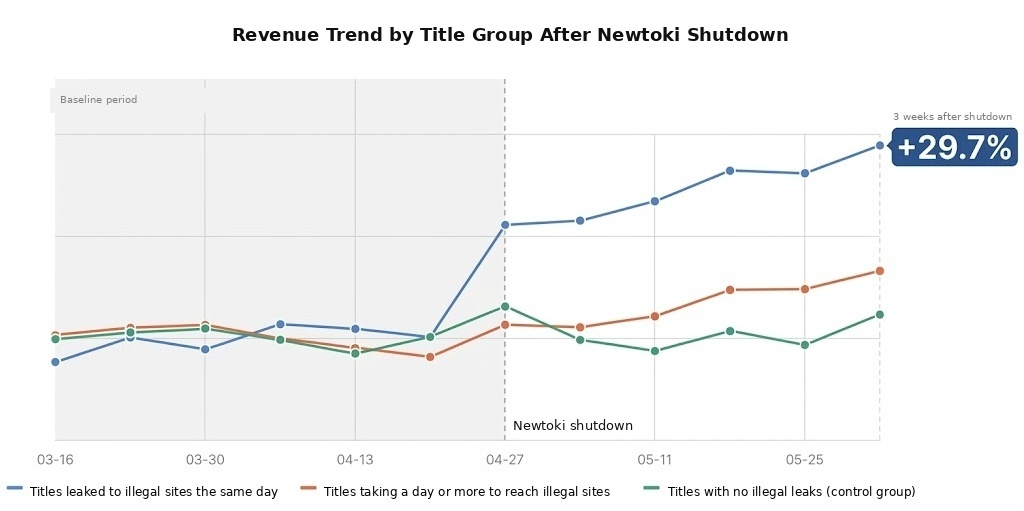
<Figure 2. Revenue Trend by Title Group After Newtoki's Shutdown — NAVER WEBTOON, Korea Domestic Service>
WEBTOON Entertainment's efforts against illegal sites operating overseas have also produced results. Recognizing that international markets differ from Korea's environment, the company has continued a multi-pronged response tailored to local conditions, including tracking down and identifying original uploaders and managing the visibility of illegal links on the first page of search results. In May, working with Korea's Ministry of Culture, Sports and Tourism (MCST), WEBTOON Entertainment shut down three Vietnam-based illegal sites with global reach; in August, in cooperation with Interpol and local law enforcement in North Africa, it shut down three English-language illegal sites drawing a combined 130 million visits annually and helped lead to the arrest of their operators.
"We’ve confirmed that blocking content leaks through systems like ToonRadar, together with the government’s proactive response leading to the shutdown of illegal sites, is effective in bringing readers back to our official service and keeping them there," said Kyunam Kim, Chief Administrative Officer of WEBTOON Entertainment. "Because this means stronger protection of creators’ rights and greater earnings for them, it carries real significance for the webcomic ecosystem." He added, "We are deeply grateful to the government and related agencies for leading the way in copyright protection through decisive emergency blocking and investigative support. We will continue to upgrade ToonRadar and strengthen cooperation with domestic and international law enforcement to protect creators’ rights and the value of their work."
ToonRadar, developed in-house by WEBTOON Entertainment in 2017, identifies, tracks and blocks the accounts of illegal distributors through invisible watermarks embedded in webcomics. The system has continued to evolve alongside changing piracy patterns, consistently blocking the channels through which the latest paid episodes reach illegal sites. In the first quarter of this year alone, ToonRadar reduced leaks occurring within 24 hours by 90% and delayed leak timing by an additional two episodes (two weeks), contributing to a 23% increase in payment revenue for the titles analyzed.